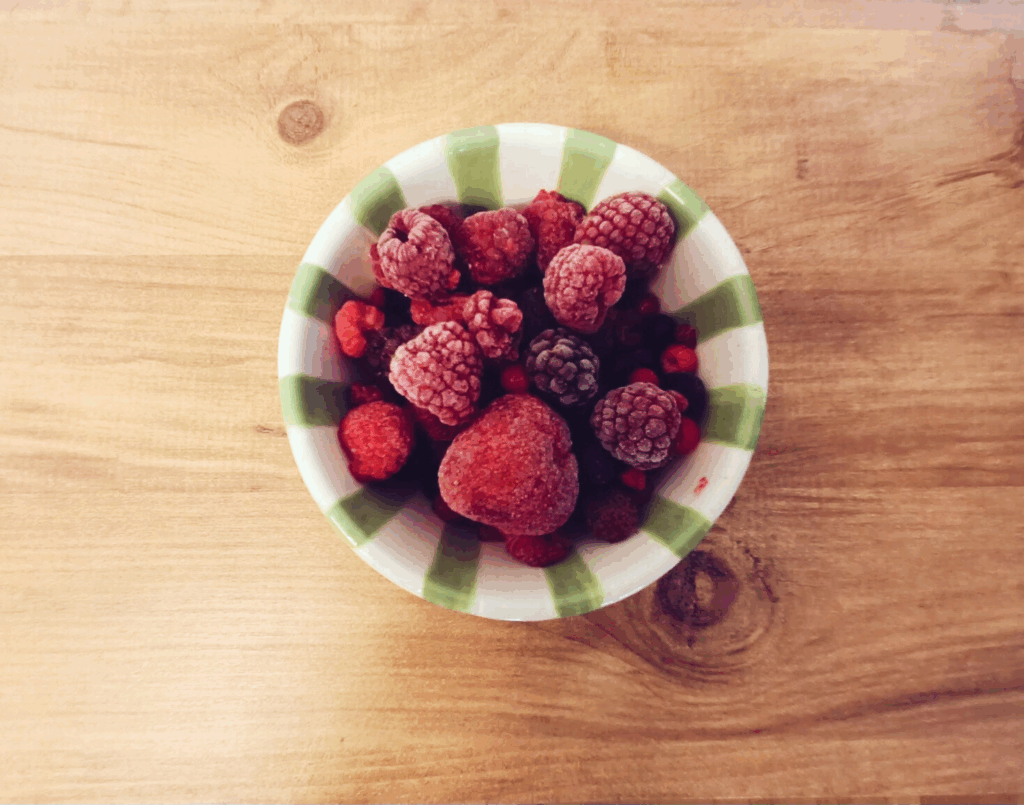
Berries are beneficial for skin health and appearance as well as for overall health. Their great advantage is their antioxidant and anti-inflammatory action due to polyphenols and Vitamins C, E, A and to a lesser extent some vitamins B.
They also contain dietary fiber and minerals. Thus, they are powerful nutrients.
Dietary fiber is linked to healthy gut and therefore to overall well-being.
Minerals such as manganese, magnesium, copper, calcium, potassium, iron and phosphorus play an important role in body functions. Copper contributes to collagen and elastin synthesis.
Vitamin C is an antioxidant and protects against damage caused by free radicals.
Vitamin K is essential for bone health, blood clotting and wound healing . Vitamins B offer many health benefits. Some berries contain also Vitamin A that plays a crucial role in some body functions and in skin health.
Red Raspberries. Source of dietary fiber, antioxidants such as anthocyanins, quercetin, ellagic acid and Vitamin C.
Anthocyanins belong to the flavonoids and give the red color. Quercetin is another flavonoid too.
Ellagic Acid, a polyphenol, has similar action.
Red raspberries contain also potassium, iron, manganese, magnesium, calcium and smaller amounts of phosphorus and copper.
They are low in calories and moderate in sugars.
They improve gut health due to the dietary fiber. A healthy gut is linked to healthy skin and overall well-being.
Blueberries. Also rich in Anthocyanins and Quercetin.
Vitamin C, A and K
Manganese
Contain also fiber for gut health and they are low in calories too.
Blackberries. Contain anthocyanins
Vitamin C and K.
High in manganese and lesser quantity of potassium.
Cranberries. Among the essential ingredients are Vitamins C, E, A and K.
Dietary fiber.
Anthocyanins, flavonols ( a type of flavonoids) and phenolic acids with antioxidant action.
Manganese, magnesium, potassium and copper are the minerals.
Black currants. Anthocyanins
Vitamin C
Several Vitamins B such as B1 (thiamin), B6 (pyridoxine) and B5 (pantothenic acid)
Fiber
Gama-Linolenic Acid an omega-6 fatty acid with anti-inflammatory action.
Iron, Calcium, Magnesium, Manganese.
They are also low in calories.
Strawberries. They are also rich nutrients because they contain Vitamins C, K and B9 (folate), manganese and potassium.
Quercetin, Ellagic Acid and Anthocyanins are the antioxidants.
Good for digestion because of the dietary fiber.
Fresh or frozen?
Fresh berries are a good choice as long as they are really fresh and not stored for a long time. They tend to lose nutrients during transport. Besides, they are more expensive.
On the other hand, frozen berries are more affordable and maintain their nutritional profile. Their properties are not affected by transport and storage.
The bottom line: Berries are great source of important nutrients that contribute to overall well-being. Their antioxidant ingredients protect against oxidative stress and premature aging. They also enhance collagen production. If they are not part of your dietary regimen, it would be a good idea to consider introducing them into your diet.